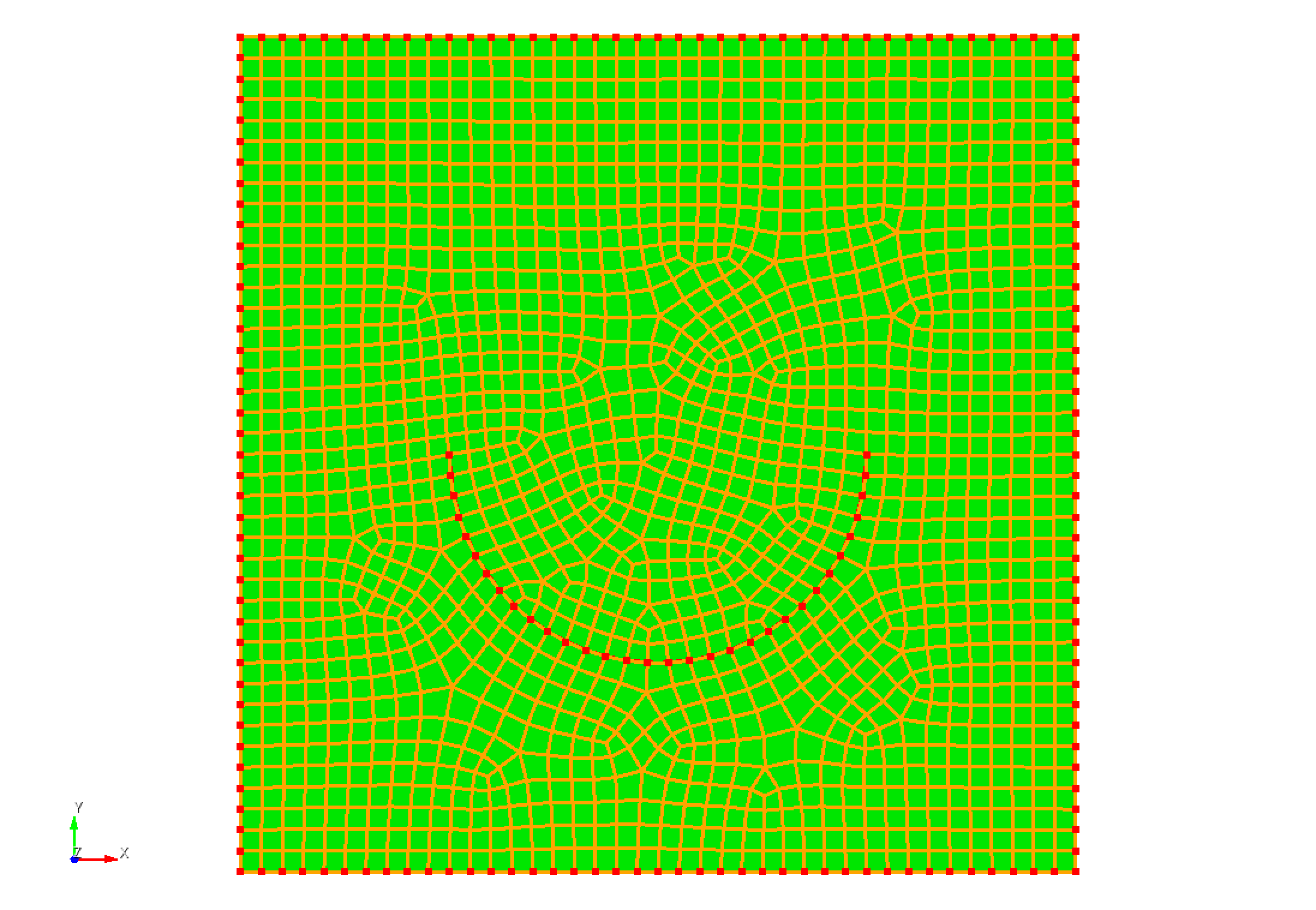
I’m looking to create a surface mesh with a non-conforming boundary in it. I want to achieve something similar to what was discussed in this thread, but I want to apply this to a surface instead of a volume.
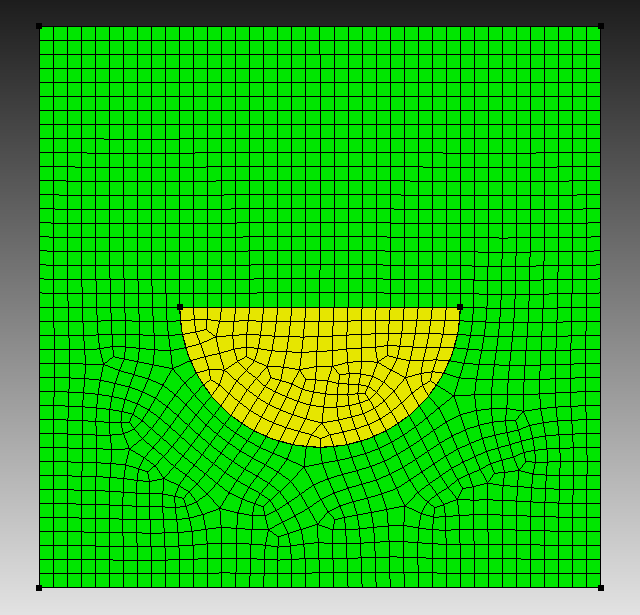
Here’s a toy problem to try and illustrate what I’m trying to do:
I want to “cut” or “disconnect” the nodes that are on either side of the interface so that the nodes on the semi-circular boundary are no longer shared by the elements on either side of the interface.
Does anyone have suggestions for how I can create such a non-conforming boundary?
Here is one way to accomplish this. If I just imprint the curve on the surface, there is only one curve at that location. If instead, I create a merged surface along that curve, I can unmerge the curve and mesh the two curves separately.
The topology check verifies that there are duplicate (coincident) nodes on the arc.
undo on
create surface rectangle width 1 zplane
create curve arc radius 0.25 center location 0 0 0 normal 0 0 1 start angle 180 stop angle 360
create curve vertex 5 6
create surf curve 5 6
subtract vol 2 from 1 keep_tool
imprint all
merge all
unmerge curve 5
surf all size .025
mesh surf all
topology check coincident node node all tolerance 1.0e-6 draw brief result group
display
high node in coincident_nodes
That indeed achieves what I’m after for this example, but I’m wondering if there’s a way of doing this without having to turn the arc into a surface first. I’m hoping to generalize this to some use-cases where the curves can’t be easily converted to surfaces due to them being quite geometrically complex.
Is it possible to do something similar with using the curve directly?